If you follow the Indian stock market, you have probably heard the names Sensex and Nifty almost every day. Both are important market indices that help investors understand the overall performance and direction of the Indian stock market. But what exactly is the difference between them? 🤔
📊 What is Sensex?
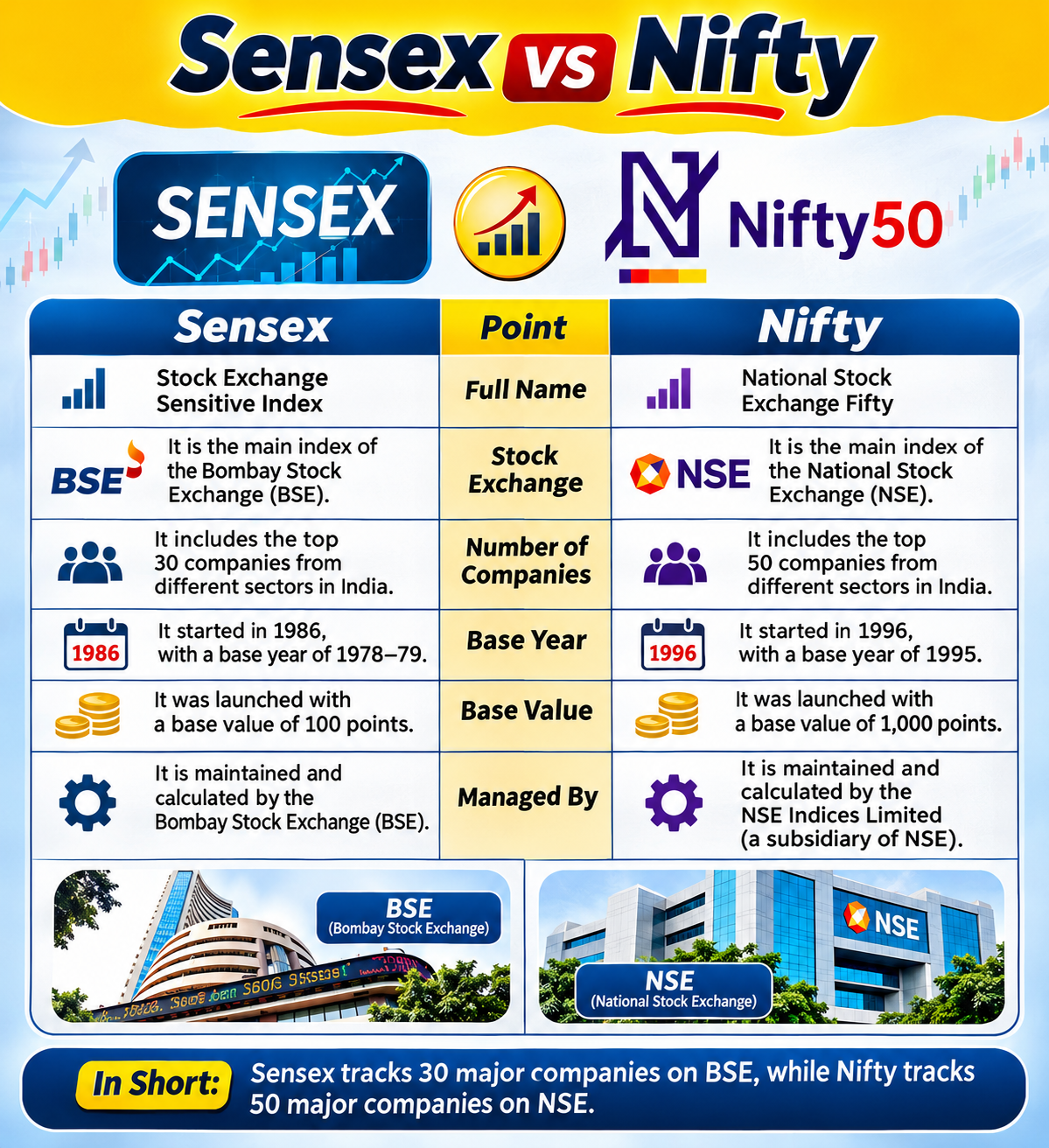
Sensex stands for the Sensitive Index and is the benchmark index of the Bombay Stock Exchange (BSE). It tracks the performance of 30 major listed companies representing different sectors of the Indian economy. These companies are selected based on various market-related criteria, and their performance helps provide an overview of the market.
Sensex was launched in 1986, with a base year of 1978–79 and an original base value of 100.
📈 What is Nifty 50?
Nifty 50 is the benchmark index of the National Stock Exchange (NSE). It tracks 50 major companies from different sectors of the Indian economy. Because it covers more companies than Sensex, it provides a broader representation of the market across selected leading stocks.
Nifty 50 was introduced in 1996, with a base year of 1995 and an original base value of 1,000.
🏛️ Who Manages Them?
Sensex is associated with the Bombay Stock Exchange (BSE), while Nifty 50 is maintained and calculated by NSE Indices Limited.
💡 The Main Difference:
Sensex tracks 30 major companies listed on the BSE, while Nifty 50 tracks 50 major companies listed on the NSE. Both indices are widely followed by investors, traders, financial analysts, and market participants to understand market trends.
📚 Understanding these two indices can help beginners learn more about stock market movements, investment trends, and India’s financial markets.